PLANNING OBJECTION SUPPORT ACROSS SCOTLAND
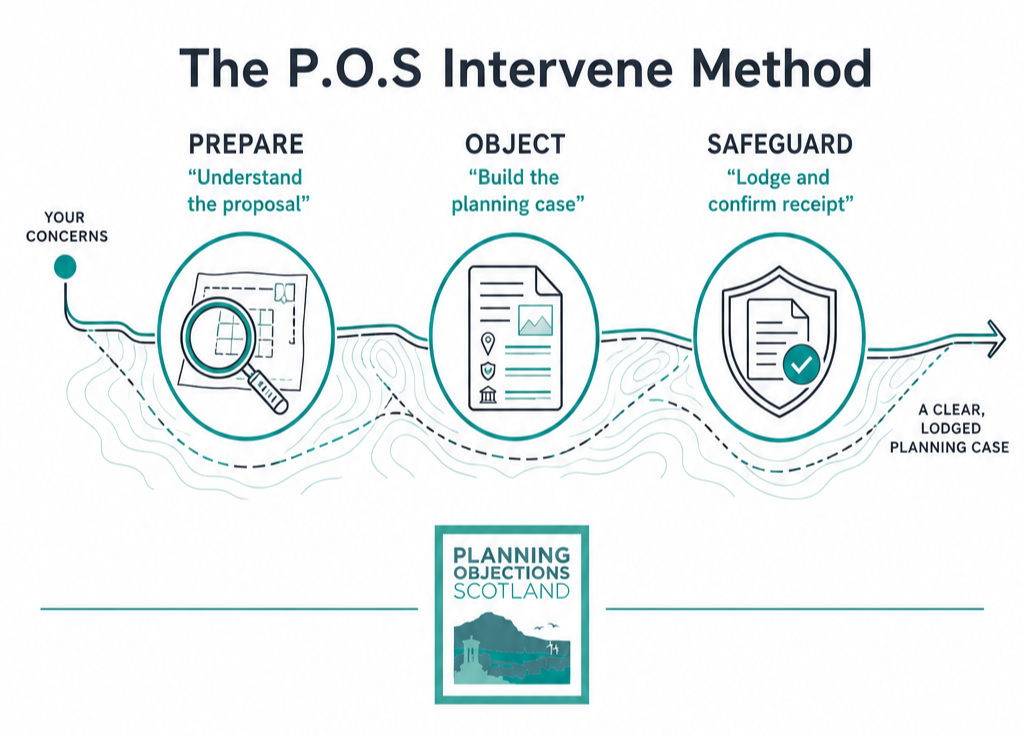
Delivered through our structured P.O.S Intervene Method (Prepare. Object. Safeguard.).
We help you object to a planning application - so your concerns are taken seriously
Planning Objections Scotland reviews live planning applications and prepares professional objections for homeowners, neighbours, businesses, residents’ groups, community councils and local organisations throughout Scotland.
Rated 5/5 on Google | 20+ years’ planning experience | RTPI and RICS professional credentials
- Confidential, no-obligation case review
- Reviewed by a professional planning consultant
- Know where you stand within 1 working day*
- Clear fixed fee before you decide to proceed
- Objection strategy based on planning policy — not emotion
Turn your concerns into a clear, evidence-led and policy-backed planning objection before the representation deadline closes.
Your Next Steps Are Simple
1. Get Your Case Reviewed
Send us the planning application reference, representation deadline and a brief explanation of your concerns.
2. Receive a Clear Proposal
We review the initial case information and confirm whether we can help, what work is recommended and the fixed fee.
3. Get Your Objection Prepared
Your concerns are assessed against the application documents, available evidence and relevant Scottish planning policy before being prepared as a structured representation.
Having a Genuine Concern Is Not the Same as Presenting a Strong Planning Case
You may already understand how a proposed development could affect your home, business or community.
The difficulty is explaining those effects in terms that are relevant to the planning decision.
A planning application can contain dozens of drawings, reports, assessments and policy references. The representation period may be short, and it is not always obvious which issues carry planning weight.
You may be concerned about:
- Loss of privacy or overlooking
- Noise and disturbance
- Traffic, parking or road safety
- Design, scale or visual impact
- Drainage or flooding
- Landscape, trees or biodiversity
- Heritage or conservation
- Pressure on local infrastructure
- The cumulative impact of several developments
Those concerns may be entirely genuine. However, general opposition, emotional language or points that are not connected to the use and development of land may carry limited weight in the assessment.
The P.O.S Intervene Method. Prepare. Object. Safeguard.
Prepare
Identify the strongest planning grounds planners must consider
Object
Turn them into policy-backed arguments that carry weight
Safeguard
Ensure your objection is formally recorded and cannot be ignored
We write objections in the way planning applications are assessed.
That means focusing on the proposal, the evidence, the development plan and the likely planning consequences.
The P.O.S Intervene Method: Planning Objections Scotland’s Workflow
Step 1: Identify the Strongest Grounds
We review the planning application in detail to identify the most effective, policy-backed reasons your objection should be considered.
Step 2: Build a Policy-Backed Objection
We turn those findings into a clear, structured objection written in the language planners use — focused on material considerations that carry weight.
Step 3: Submit and Safeguard Your Position
We finalise the objection with you and lodge it correctly with the planning authority, ensuring your concerns are formally recorded and cannot be ignored.
What Exactly do I get from The P.O.S Intervene Method
From Uncertainty to a Structured Planning Case
Late-night anxiety
Calm confidence with an expert at your side
Angry email rants
Clear, material considerations that hold legal weight
Being dismissed as "nimby"
Being respected as an informed local resident
Watching bad planning happen
Actively shaping what happens next
The result is not simply a longer objection – it’s a mental shift. You become someone planners have to take seriously. It is a clearer, more relevant and better-structured planning case.
Find Out Whether Your Concerns Have Planning Grounds
Send us the application reference. We’ll review the initial information and respond within one working day to confirm whether we can assist and what the recommended next step would be.
What Your Planning Objection Service Includes
Every case is different. The precise scope depends on the proposal, the available documents, the issues involved and the time remaining before the representation deadline. Although the following core stages usulally apply.
- Application status and representation deadline check
- Confirmation of the planning authority and application reference
- Review of the proposal description and application type
- Initial identification of potential planning issues
- Consideration of the available time and appropriate intervention
- Clear fixed-fee proposal before work begins
- Review of relevant drawings and plans
- Review of the planning statement or design and access statement
- Review of publicly available supporting documents
- Consideration of relevant technical reports
- Review of the application site and surrounding context
- Identification of omissions, inconsistencies or unclear information
- Review of relevant planning history where appropriate
- National Planning Framework 4
- Relevant local development plan policies
- Applicable supplementary guidance
- Relevant planning advice or standards
- Development-plan compliance
- Material and non-material planning considerations
- The principle of development where relevant
Depending on the nature of the proposal, this may include:
- Privacy and overlooking
- Daylight and sunlight
- Residential amenity
- Noise and disturbance
- Design, scale, massing and layout
- Character and appearance
- Landscape and visual impact
- Traffic, parking and road safety
- Access and servicing
- Drainage and flood risk
- Trees, habitats and biodiversity
- Heritage assets and conservation areas
- Lighting and operational impacts
- Construction impacts
- Local infrastructure and open space
- Sustainability and climate considerations
- Cumulative and precedent impacts
- References to relevant plans, reports and evidence
- References to relevant national and local planning policy
- Explanation of the likely planning consequences
- Separation of facts, client observations and professional analysis
- Clear planning outcome sought
- Recommended amendments, safeguards or conditions where appropriate
- Professionally formatted final document
- Client review of factual information
- Agreed factual corrections
- Revision and final proofing
- Final submission-readiness check
- Submission to the planning authority
- Copy of the final representation
- Submission confirmation and reference details where available
One integrated process
Instead of trying to coordinate research, policy analysis, drafting, revisions and submission yourself, POS Intervene provides one structured route from initial concern to completed planning representation.
Why Most Objections Get Ignored
Emotional arguments
No policy grounding
Poor structure
Most objections fail not because the issue isn’t real — They fail because they are written in a way planners can dismiss.
Many self-written objections contain valid concerns but do not clearly connect them to:
- Material planning considerations
- Evidence within the application documents
- National Planning Framework 4
- Relevant local development plan policies
- The specific planning outcome being requested
The result can be a representation that explains how strongly you feel, but does not give the planning officer a clear policy and evidence-led case to assess.
That is the problem the P.O.S Intervene Method is designed to address.
A comprehensive Professional Planning Objection — Not a 3-5 Page Generic Template
Your objection is prepared specifically for the planning application, site, circumstances and issues affecting you. It is not a standard 3-5 page letter with your details inserted.
Depending on the application and the issues identified, a POS planning objection will typically include:
- Introduction and Key Issues — setting out who is objecting, the application being considered and the principal concerns requiring assessment.
- Review of the Planning Application — examining the proposal, drawings, supporting documents and relevant information submitted by the applicant.
- Site and Planning Context — explaining the location, surrounding development, planning history and circumstances relevant to the decision.
- Planning Policy Analysis — identifying the relevant National Planning Framework 4, Local Development Plan and other applicable planning policies.
- Material Planning Considerations — assessing the specific impacts that may influence the decision, such as amenity, privacy, design, traffic, landscape, drainage, heritage or other relevant issues.
- Evidence-Led Grounds of Objection — bringing the application documents, planning policy and your local evidence together into clear, structured grounds of objection.
- Conclusion and Planning Outcome Sought — summarising the case and clearly explaining whether refusal, amendments, further information, mitigation or planning conditions should be considered.
The objective is simple:
To turn your concerns into a structured planning case that explains what the problem is, what the evidence shows, which planning policies apply and what the planning authority should do about it.
We Support People and Organisations Across Scotland
Homeowners
Neighbours
Protect residential amenity by presenting concerns about privacy, overlooking, daylight, noise, design, traffic and other relevant impacts in planning terms.
Businesses
Commercial Operators
Address potential effects on access, servicing, operations, customers, noise-sensitive activities and the conditions needed to avoid harmful impacts.
Residents’ Groups
Residnet Associations
Bring together local evidence and shared concerns within a clear and professionally structured planning representation.
Community Councils
Development Trusts
Support formal engagement with complex applications by identifying relevant policy issues, potential impacts and appropriate planning outcomes. Development Trusts and Local Organisations
Planning Permission Is Usually Granted — Which Is Why a Strong Objection Matters
Across Scotland, 92.2% of planning applications were approved in 2024/25.
That means refusal is the exception rather than the norm.
Against that backdrop, 55.3% of the planning applications in POS objection cases were subsequently either refused or withdrawn.*
That is equivalent to around 7.1 times the national refusal rate.
Why does that matter?
It does not mean that submitting a professional objection guarantees refusal — and every planning application must be determined on its own merits.
It does demonstrate why simply saying that you oppose a development is not enough.
The P.O.S Intervene Method — Prepare. Object. Safeguard. is designed to identify the planning issues that matter, connect them to the relevant evidence and policy, and present them clearly to the planning authority.
Planning Objection Experience Across Scotland
Every planning application turns on its own facts, policies and evidence. Previous outcomes cannot guarantee the result of another case, but they demonstrate the range of proposals and issues POS has experience reviewing



What Clients Say About Planning Objections Scotland
Rated 5/5 on Google* as of August 2026
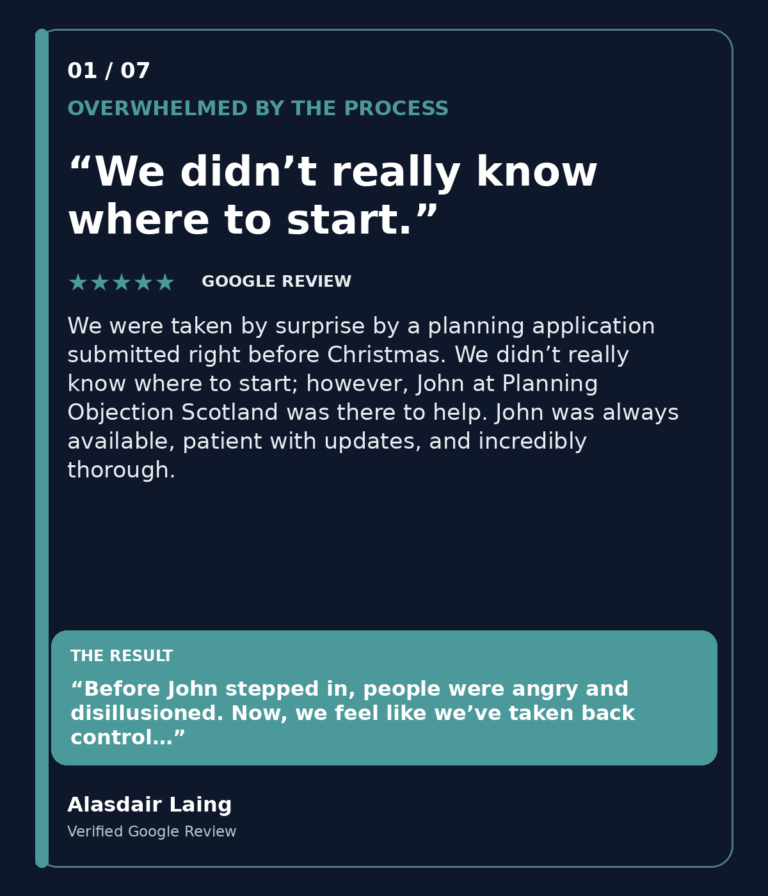
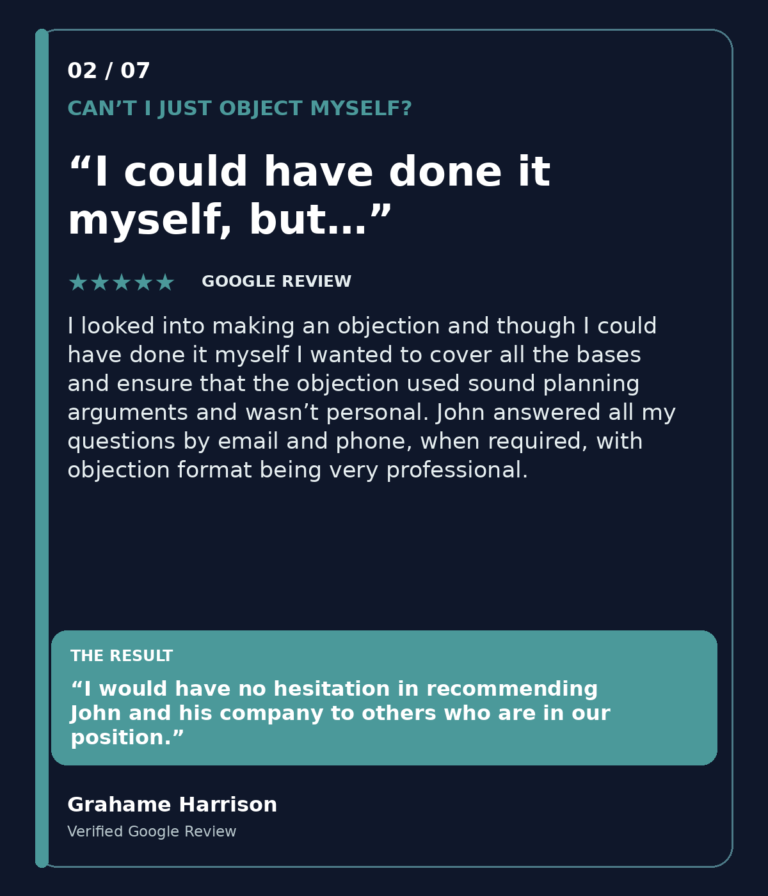


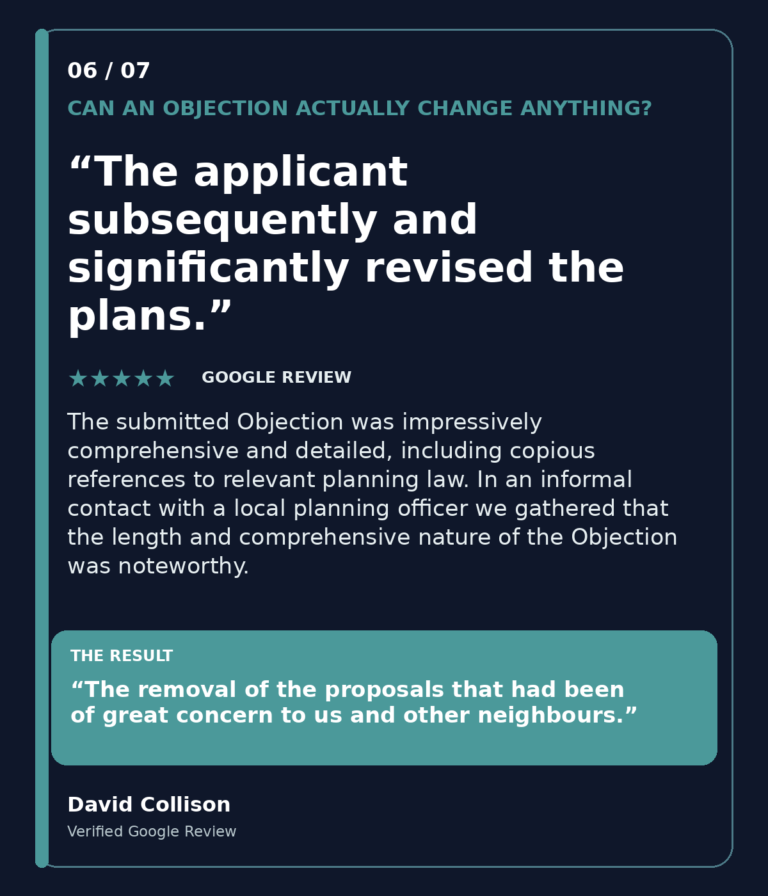

Explore our Google Reviews and Planning Objection Success Stories to see how Planning Objections Scotland has helped homeowners, businesses and communities present stronger planning cases and achieve positive outcomes.
Your Case Is Reviewed by an Experienced Scottish Planning Consultant
Planning Objections Scotland is led by John Russell, a planning and development consultant with more than 20 years’ experience across the public and private sectors.
Having worked within the planning system, John understands how applications are assessed, how planning officers review representations and why some objections carry more weight than others.
Every POS Intervene instruction is approached as an individual planning case. The aim is to identify the strongest legitimate issues and present them accurately, clearly and professionally.
Professional reassurance
- More than 20 years’ planning experience
- Public and private-sector background
- MRTPI — Chartered Member of the Royal Town Planning Institute
- AssocRICS — Associate Member of the Royal Institution of Chartered Surveyors
- Professional indemnity insurance
- Scotland-wide planning objection service
- Written terms of engagement
- Clear fixed-fee proposal before work begins

Direct professional support
You know who is reviewing your case, who is preparing the objection and who is responsible for ensuring that the agreed work is completed.
Clear Fixed-Fee Pricing Before Any Work Begins
- Domestic extensions, alterations, garden additions (garages, sheds, tree houses, hardstanding’s, engineering operations) to an existing Dwelling House.
- Including associated Listed Building Applications and Conservation Area Consent Applications and Applications to vary planning conditions under Section 42.
- New or replacement dwelling-houses and flats. Residential developments under 50 units / developed area of site under 2 hectares.
- Change of use applications, Houses in Multiple Occupation, Student Accommodation.
- Telecommunication Infrastructure.
- Retail Development under 5,000sqm / area of the site is under 2 hectares.
- Business and General Industry, Storage and Distribution gross floor space under 10,000 sqm / area of the site is under 2 hectares.
- Energy Generation under 20 Mega Watts.
- Transport and Infrastructure under 8 kilometres.
- Fish Farming surface area of water covered is under 2 hectares
- Mineral Applications area of the site is under 2 hectares.
- Including associated Listed Building Applications, Conservation Area Consent Applications, Hazardous Substance Consent Applications and Applications to vary planning conditions under Section 42.
- New or replacement dwelling-houses and flats. Residential developments over 50 units / developable area of site over 2 hectares.
- Retail Development over 5,000sqm / area of the site is over 2 hectares.
- Business and General Industry, Storage and Distribution gross floor space over 10,000 sqm / area of the site is over 2 hectares.
- Energy Generation over 20 Mega Watts.
- Transport and Infrastructure over 8 kilometres.
- Fish Farming surface area of water covered is over 2 hectares
- Mineral Applications area of the site is over 2 hectares.
- Including associated Listed Building Applications, Conservation Area Consent Applications and Hazardous Substance Consent Applications.
The POS Professional Preparation Promise
If We Miss the Mark, You Get 100% of Your Money Back.
When you instruct Planning Objections Scotland, you are trusting us to turn your concerns into a clear, evidence-led and professionally prepared planning objection.
Whether you are a homeowner, business owner, landowner, residents’ group or community organisation, the expectation is simple:
We deliver the planning objection service we agreed to provide — clearly, professionally and to the standard set out in your written scope.
If we fail to do that, we put it right.
If we cannot put it right:
- Not a partial refund.
- Not a credit note.
- All your money. Back in your bank.
You will have the opportunity to review the factual information before the objection is finalised, and any agreed corrections will be made before submission.
We do not guarantee that a planning application will be refused, withdrawn or amended. That decision remains with the relevant planning authority.
What we do guarantee is the quality of the professional service you have instructed us to provide.
We either deliver an objection you are confident to submit — or we refund the fee.
Better Than Doing Nothing. Far Better Than Doing It Wrong.
An unsuitable development can have long-lasting consequences. The potential costs associated of not using The P.O.S Intervene Method
Devaluation of your home due to inappropriate development
Potential to preserve £5k–£20k+ in property value
Increased traffic, noise, or safety risks
Avoids £2k–£10k in future mitigation deployment (fencing and landscaping)
Emotional stress of reacting too late
Saves weeks/months of potential disputes and planning
Legal costs to reverse bad planning
Saves £2k–£10k+ in post-decision legal costs
Objecting does not guarantee that permission will be refused.
However, failing to participate—or submitting a representation that does not explain the relevant planning issues—may reduce your opportunity to influence the assessment before the decision is made.
The time to present your planning case is while the application is live.
Act Before the Representation Deadline Closes
Planning applications normally have a defined period during which representations can be submitted.
Starting early provides more time to:
- Review the application documents
- Identify missing or inconsistent information
- Gather photographs and measurements
- Consider relevant planning history
- Review national and local policy
- Clarify the outcome being requested
- Prepare and check the final objection
- Submit through the appropriate route
Urgent cases may be considered where the required information is available and sufficient time remains.
Where the deadline is very close, it may be necessary to prioritise the most important material planning issues.
Do not wait until the final day to find out whether you have a case.
Your Next Steps Are Simple
1. Get Your Case Reviewed
Send us the planning application reference, representation deadline and a brief explanation of your concerns.
2. Receive a Clear Proposal
We review the initial case information and confirm whether we can help, what work is recommended and the fixed fee.
3. Get Your Objection Prepared
Your concerns are assessed against the application documents, available evidence and relevant Scottish planning policy before being prepared as a structured representation.
GET YOUR CASE REVIEWED
Find Out Whether Your Concerns Can Be Turned Into a Stronger Planning Case
Your Questions Answered
Your case is reviewed from the perspective of Scottish planning policy and decision-making.
Depending on the agreed scope, we review the relevant application documents, identify the strongest material planning issues, consider the available evidence, assess relevant policy and prepare a clear, structured objection.
Where submission is included and sufficient time remains, we can also lodge the representation through the appropriate planning authority process and provide confirmation.
P.O.S Intervene means Prepare, Object and Safeguard.
We prepare by reviewing the proposal, identifying what matters and considering the relevant evidence and policy.
We object by presenting the concerns in a clear representation focused on legitimate material planning considerations.
We safeguard by identifying the strongest realistic planning outcome, which may include refusal, amendments, additional information, mitigation or enforceable conditions.
No.
The planning authority determines the application, and no planning consultant can responsibly guarantee a particular decision.
The purpose of POS Intervene is to improve the clarity, structure, relevance and evidential basis of your representation so that your strongest legitimate concerns can be properly assessed.
Material planning considerations relate to the use and development of land.
Depending on the proposal, they may include:
- Design and appearance
- Scale and massing
- Privacy and overlooking
- Daylight and sunlight
- Residential amenity
- Noise and disturbance
- Access, parking and road safety
- Drainage and flooding
- Landscape and visual impact
- Trees and biodiversity
- Heritage and conservation
- Pollution and environmental effects
- Infrastructure
- Cumulative impacts
- Compliance with planning policy
Each application is different, and the relevance and weight of any issue will depend on the individual circumstances.
Matters that may carry little or no planning weight include:
- Private boundary disputes
- Ownership disagreements
- Competition between businesses
- Personal dislike of the applicant
- The identity or character of the applicant
- Loss of property value on its own
- Matters controlled entirely by other legal regimes
Some concerns can be reframed where there is a legitimate planning connection. For example, a concern about property value may reflect underlying issues involving noise, privacy, traffic or amenity.
Yes.
You do not need to understand planning policy before contacting us.
Explain what concerns you, what may be affected and what outcome you believe is needed. We will assess whether those concerns can be connected to relevant planning issues, evidence and policy.
The service is available to:
- Homeowners
- Neighbours
- Businesses
- Residents’ groups
- Community councils
- Development trusts
- Local organisations
- Landowners
- Other parties affected by a live planning application in Scotland
Urgent cases may be considered where sufficient time remains and the necessary information is available.
The sooner you contact us, the more opportunity there is to review the documents, identify the strongest issues and prepare an accurate representation.
Where time is very limited, the review may need to focus on the most important material planning grounds.
To undertake an initial review, we normally just need:
- The planning authority
- The planning application reference number
Any additional evidence can be discussed as part of our confidential case review.
Yes.
Submission forms part of the Safeguard stage of the P.O.S Intervene Method.
Once you have approved the final objection, we submit it to the relevant planning authority through its accepted representation process on your behalf.
You will then receive:
- A copy of the final planning objection
- Confirmation that it has been submitted
- Submission or reference details where provided by the planning authority
This means the service does not stop when the objection is written. We take it through to submission so your representation is formally lodged with the planning authority before the agreed deadline.
If amended plans, revised drawings or additional information are lodged on the planning portal after your objection has been submitted, the first thing to do is let us know—particularly if you think the changes could have implications for the work already undertaken.
We can then review the new information and confirm whether:
- The amendments affect any of the grounds already raised
- The applicant has addressed, reduced or introduced new planning concerns
- A further response would strengthen or protect your position
Any additional review or supplementary representation would be discussed with you and agreed separately before further work is undertaken.
Prices currently start from:
- £225 for householder applications
- £259 for other local applications
- £369 for major, national or EIA development
The final fixed fee depends on the scale and complexity of the case, the number of documents, the issues involved and the time available.
A written quotation is issued before any paid work begins.
Yes. Planning Objections Scotland provides a Scotland-wide service.
Applications can normally be reviewed remotely using the planning authority’s online portal, maps, photographs, client evidence and publicly available information.
Where a site visit or additional specialist input would be beneficial, this will be discussed separately.
We check the application details, deadline and initial information.
We then confirm:
- Whether we can assist
- The recommended scope
- The fixed fee
- The information required
- The anticipated programme
- Any important limitations
You then decide whether to proceed.
Before the Deadline Closes, Make Sure Your Concerns Are Presented Properly
A planning objection is your formal opportunity to explain how a proposed development may affect your home, business or community before the application is determined.
POS Intervene helps turn those concerns into a clear, evidence-led and policy-backed planning case.
Prepare the evidence.
Object on relevant planning grounds.
Safeguard what matters.